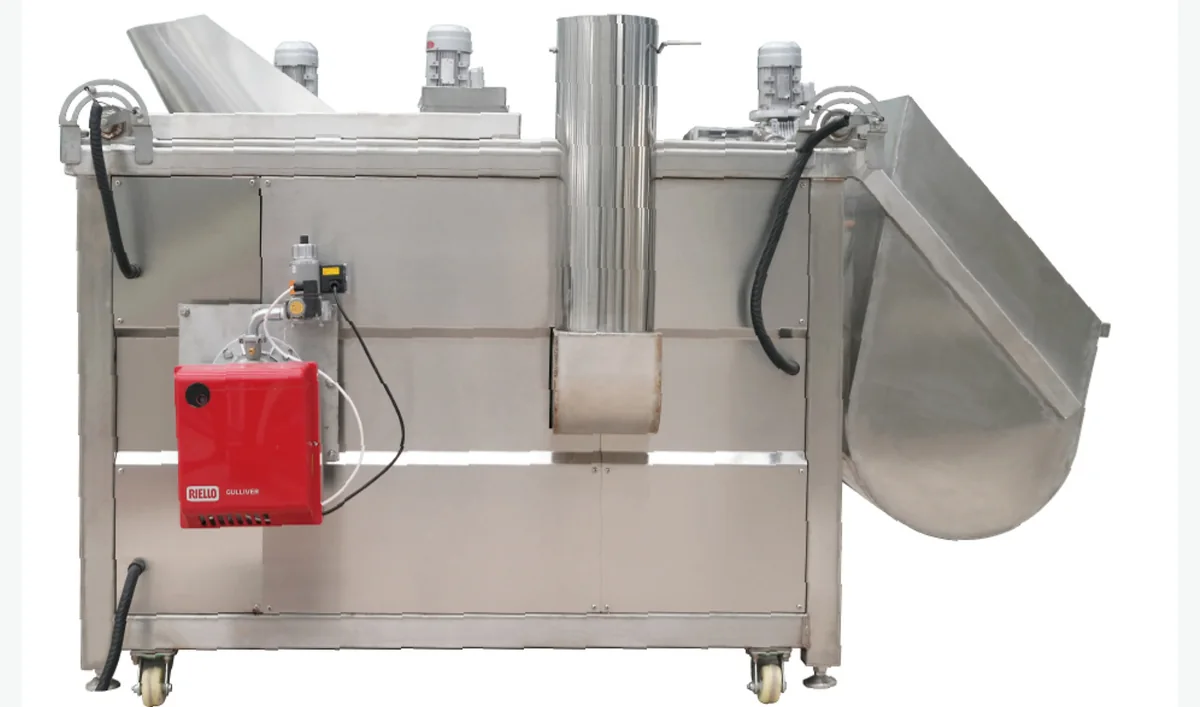
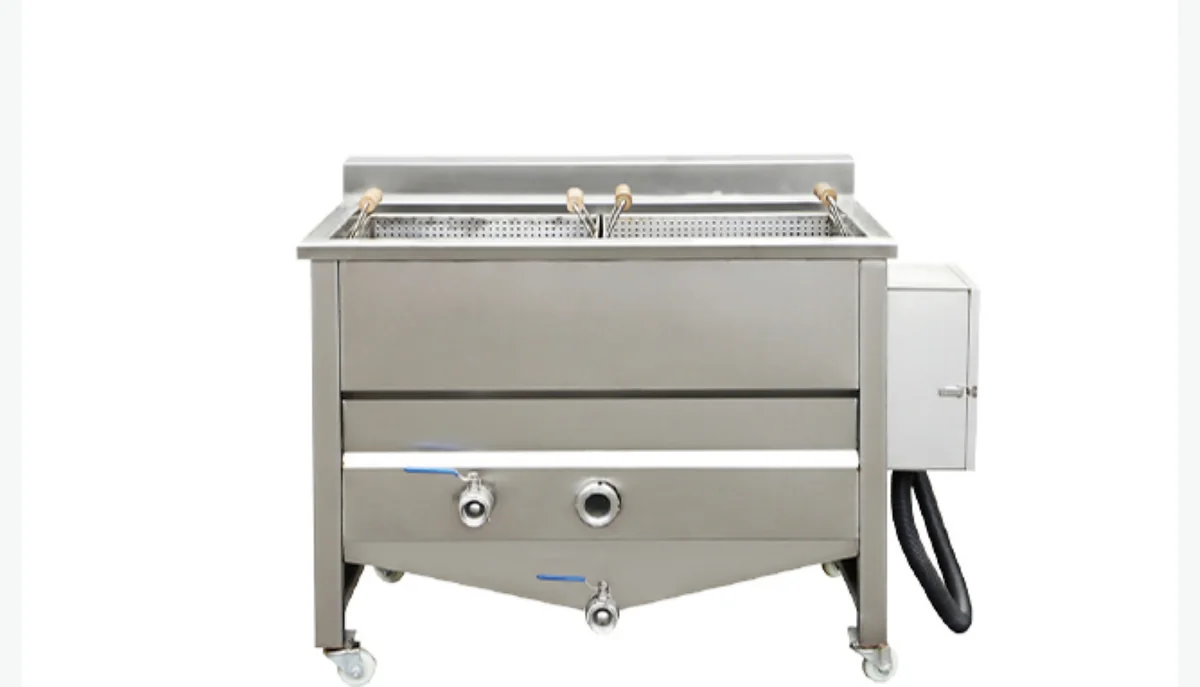
Two quotations arrive for what looks like the same job: a small frying operation, several products, batches measured in a few kilos rather than tonnes per hour. One supplier offers a round pot stirring fryer, the other an industrial batch fryer. Both are described as batch machines, both are quoted against the same batch weight, and on paper they appear interchangeable.
They are not interchangeable, but the difference is not about which one is "better". It sits in three places: whether the product needs to be moved inside the oil, how the finished batch leaves the vessel, and how much of the shift is spent changing over between products. Everything else — heating, oil volume, filtration, downstream steps — follows from those three answers.
1. The batch cycle is shared; the handling is not
A batch fryer, in the general sense, runs a fixed sequence: load a quantity of product, fry it at a controlled temperature for an agreed time, drain or de-oil it, then transfer it to cooling or seasoning. The published process sequence for the batch fryer on this site is exactly that — batch loading, controlled-temperature frying, oil draining or deoiling, transfer to cooling or seasoning.
The round pot stirring fryer runs the same sequence with two additions: the product is mixed during frying, and the batch leaves through a lift-assisted discharge. Its published sequence is product loading, stirred batch frying, oil draining, then lift discharge to cooling or seasoning.
So the comparison is not batch versus continuous — that decision is covered separately in the batch versus continuous fryer guide and should be settled before this one. This page assumes the operation has already concluded that batch frying is the right production mode, and asks which batch machine to specify.
2. What the two handling methods change
The stirring case
Mixing keeps product moving through the oil instead of letting it sit in one position. That matters when pieces would otherwise stack, when one face would stay against the heating surface longer than another, or when the load is dense enough that oil cannot circulate freely around each piece. The round pot fryer is described for meat, flour products, vegetables and beans — products suitable for stirred batch frying — which is a statement about handling, not about output.
The static case
A static batch fryer leaves the load in the oil and controls the frying through temperature and time. Its configuration points are batch size and oil volume, selected around the product frying curve, plus oil handling, filtration, ventilation and operator safety. It is also the machine whose heating can be reviewed as electric or gas once local energy conditions are confirmed — a detail worth checking early, because it can decide the site works before the machine is even ordered.
Neither description promises a finished-product result. Both pages place capacity, batch weight, frying time, temperature and heating source in the "confirm before quotation" list, which is the honest position: the same vessel handles very different products with different settings.
3. Agitation is a product decision, not a feature decision
Stirring is usually presented as an upgrade. In practice it is a trade. Movement helps even frying and prevents pieces from fusing, and it also applies mechanical force to the product while the surface is at its most fragile — during the first minutes in hot oil, when a coating is setting and a surface is dehydrating.
That is why the round pot fryer page instructs buyers to check the mixing action against product fragility and coating, and why its first FAQ asks how stirring suitability is checked for coated or fragile foods. The answer given there is a trial: run the intended product with the proposed mixing action, batch weight and frying conditions, then inspect coating retention, breakage and finished condition before confirming the stirring arrangement.
Three product families deserve that trial specifically:
- Coated and battered products — the coating is the product. Breakage or coating loss in the trial is a specification issue, not a cosmetic one.
- Dough and flour products — pieces deform and can stick to each other; movement helps separation but also adds shear.
- Soft or cooked-flesh products — meat and some vegetables can break at the edges under continuous agitation.
Run the same trial on a static batch fryer with the same product and compare. If the static result is acceptable and the stirred result is not, the decision is made. If both are acceptable, the stirring machine earns its place through labour and rhythm, not through product quality.
4. Discharge method sets the labour rhythm
In a batch process the crew cost is not in the frying — it is in loading, draining and unloading. A lift-assisted discharge removes part of that manual handling, but it is not a free upgrade: it needs a discharge direction, a receiving container or conveyor, and enough operator and equipment space for the lifting arrangement. The round pot fryer page lists exactly those points as the items to agree before the discharge method is confirmed.
The static batch fryer discharges after draining or de-oiling, and the transfer to cooling or seasoning is part of the quoted sequence. Whether that transfer is manual, by container, or by conveyor is a scope question that belongs in the offer, not in the assumption.
Whichever machine is chosen, the cycle review should include loading, frying, draining and discharge together, and the receiving stage should be matched to that rhythm rather than to the fryer alone. A fryer that empties faster than the next stage can accept product has not gained capacity; it has moved the queue.
5. Changeover between products is where small-batch projects lose money
The reason a processor chooses batch frying is usually variety: several products, short runs, recipes that change during the week. That advantage only exists if changeover is short enough to keep the runs short.
Ask both suppliers the same four questions, and ask for the answers as steps rather than as minutes:
- What has to be emptied, opened or removed before the next product can be loaded?
- Is the residue between batches removable without draining the whole oil volume?
- Does the stirring element or the discharge mechanism add cleaning surfaces that need access?
- Where does the operator stand, and what does the operator handle by hand, during cleaning?
A stirring machine adds a component in the oil and a lifting mechanism outside it. Both are cleaning and maintenance surfaces, and both should be visible in the layout rather than discovered at commissioning. A static machine is simpler to clean but leaves more of the loading and unloading to people, which is the cost it trades against.
6. Oil volume, filtration and ventilation
On a batch fryer, batch size and oil volume are selected together around the product frying curve: a load that is large relative to the oil volume drops the oil temperature sharply at loading and forces a longer recovery before the next batch. That relationship is a specification item, not a rule of thumb with a fixed ratio — it has to be worked out against the actual product and the actual batch weight.
Oil handling, filtration, ventilation and operator safety are all listed as project-specific review items for the batch fryer, and the same review applies to a stirring fryer. Residue behaviour differs by product: starch and crumbs from potato products, flour and batter from coated goods, sugar-bearing residues from fruit and vegetable chips. The oil filtration guide sets out the filtration levels and the cleaning-access questions, and most of its logic transfers directly to batch equipment even though it is written around continuous fryers.
Ventilation belongs in the same conversation. Frying generates vapour and odour that have to leave the room, and a small batch operation in an existing building often has less headroom and less duct space than a purpose-built line. Raise it before the layout is drawn.
7. Match the fryer to the stages after it
The fryer is rarely the last machine. A batch fryer normally hands over to de-oiling, cooling and seasoning, and the choice between the two fryer types changes what those stages have to absorb.
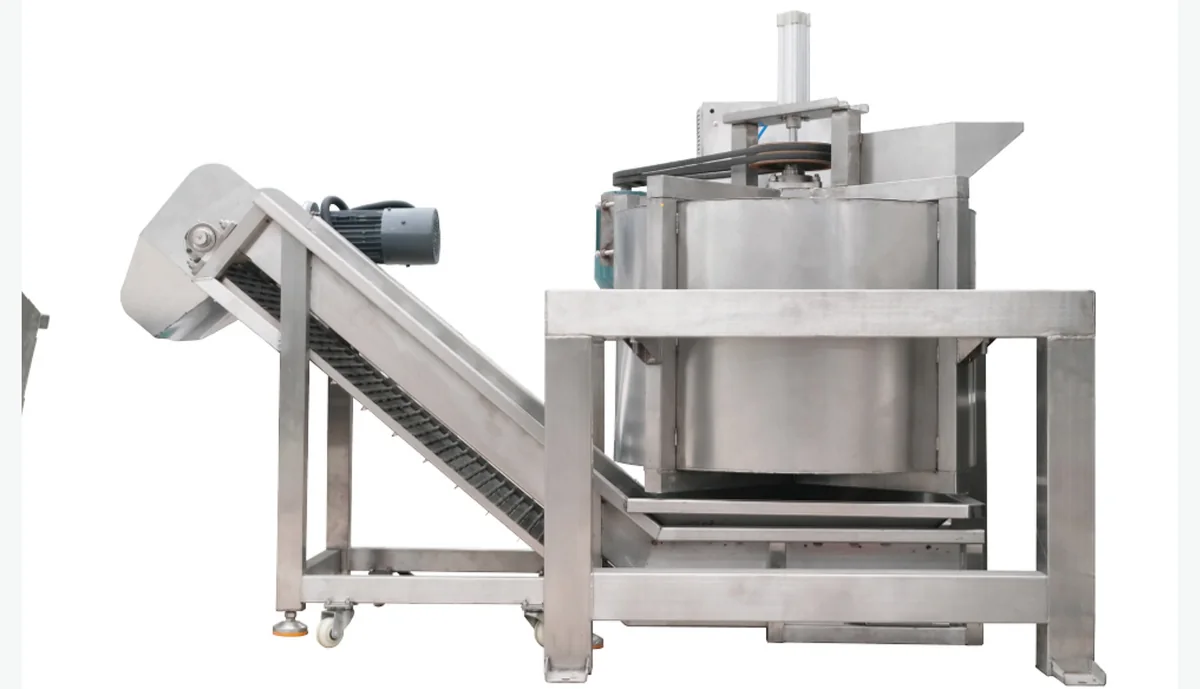
De-oiling: a centrifugal de-oiling machine is a batch device in its own right, so the two batch rhythms have to be added together, not optimised separately. If the fryer is quoted with draining only, the de-oiling step has to be accounted for somewhere.
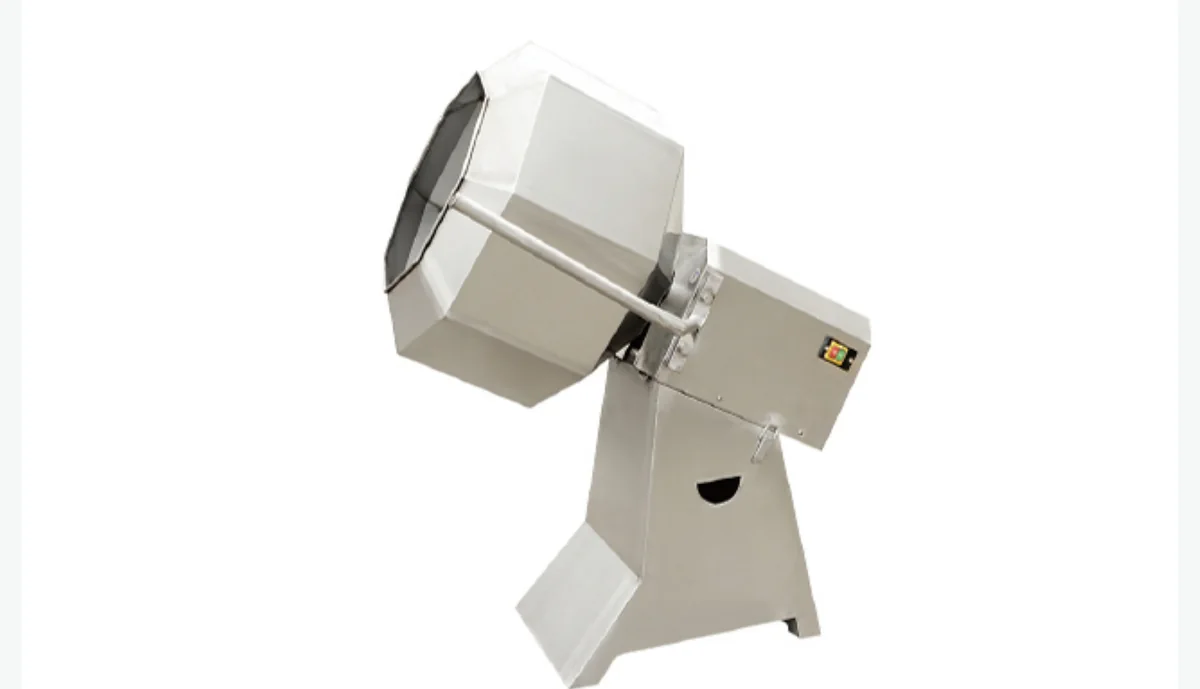
Seasoning: a batch seasoning machine works on a defined batch, which matches a batch fryer naturally. The question is whether the seasoned batch then waits, and for how long, before packing.
Cooling: product leaving hot oil carries heat into the next stage. Whether cooling is a separate step, part of the transfer, or simply a waiting period is a layout decision that also decides floor space.
For projects where the product mix is narrow and the schedule is stable enough to consider a connected process instead, the comparison belongs in the batch and continuous fryer guide and the machine itself on the continuous belt fryer page.
8. Heating source and site conditions
For the batch fryer, electric or gas heating can be reviewed once local energy conditions are confirmed. For the round pot fryer, the heating source and the stirring arrangement are configured after the product and utility review — the page does not commit to a fixed heating option, which is the correct position for a machine configured per project.
Either way, settle these before the quotation is compared: available electrical supply with voltage, phase and frequency; whether gas is available and at what condition; the heating source the site can actually support; water and drainage for cleaning; floor space and doorway width for delivery; and the height and direction of the transfer into and out of the machine. The utility planning guide lists the sequence for working these through.
9. What the acceptance trial has to prove
Both product pages treat acceptance as something defined before the order, not after delivery: agree the sample material, the test condition, the finished-product standard, the inspection point and the service boundary, so that model selection and quotation rest on the same facts.
For this particular comparison, a useful trial covers the whole cycle rather than the frying alone:
- Load the agreed batch weight and record the time from loading to the first piece entering the oil.
- Fry at the agreed temperature and time, and record the oil temperature recovery after loading.
- Drain for the agreed period, and de-oil if that stage is in scope.
- Discharge using the proposed method, and record breakage and coating loss at the discharge point.
- Inspect the finished product against the agreed standard, and note where in the batch the outliers came from.
- Clean down between two products, and record the steps and the surfaces involved.
That record is what turns a comparison into a decision. It also gives both suppliers the same basis for a quotation, which is the point of the equipment RFQ checklist.
Selection checklist
- Production mode confirmed as batch, not continuous
- Every product listed, with coating, fragility and shape range
- Stirring suitability trialled on the real product, not assumed
- Batch weight and frying time stated on the same basis
- Discharge method, receiving container or conveyor, and operator space agreed
- Changeover steps counted between products
- Oil volume, filtration and ventilation reviewed with the fryer
- De-oiling, cooling and seasoning rhythm matched to the fryer cycle
- Heating source and site utilities confirmed in writing
- Acceptance trial defined before the order
Frequently asked questions
Is a round pot fryer the same as a batch fryer?
Not in configuration terms. A round pot stirring fryer is a batch fryer that adds product mixing and lift-assisted discharge to the batch cycle. A batch fryer in the general sense loads a quantity, fries it at controlled temperature and then drains or de-oils it. Both fry one batch at a time; they differ in how the product is handled inside the oil and how it leaves the machine.
How do I know whether my product tolerates stirring?
Test it. Trial the actual product with the proposed mixing action, batch weight and frying conditions, then inspect coating retention, breakage and finished condition. For coated or fragile foods, that trial is the only reliable basis for confirming the stirring arrangement.
Which machine suits coated products better?
That depends on the coating and the mixing action, not on the machine category. Coating can be knocked off by agitation, and it can also settle or stick when the product sits still. Trial both handling methods with your own coated product and compare coating retention and breakage before deciding.
Can batch capacity be compared directly between quotations?
No. Compare on the same product, the same batch weight and the same frying time, and include loading, draining and unloading in the cycle. A batch weight on its own does not establish hourly finished-product output, and two quotations can quote the same weight with very different cycle times.
Should oil filtration be ordered with the fryer?
Review it together with the fryer rather than later. Agree oil handling, residue removal, filtration and ventilation against your product and operating rhythm, and state in the offer which modules and which site works are included.