Most roasting projects that disappoint are not let down by the drum. They are let down by something agreed too loosely before the drum was chosen: which material, in what condition, roasted to what endpoint, cooled how, and packed into what. The machine can only repeat what the project defined.
This guide sets out the planning sequence for a sesame and nut roasting line: the material specification first, then impurity removal, the roast endpoint, the heat source and its control scope, cooling, seasoning, changeover and the acceptance test. Every capacity, temperature, time, energy and price figure in it is deliberately left as on request or to be confirmed, because those figures belong to your material and your trial, not to a generic page.
1. Roasting is a flavour process, not a drying step
Roasting and drying are neighbours in a factory layout and nowhere else. Drying is bought as a water-removal duty: a stated water load per hour, taken down to a target moisture, proven by sampling. Roasting is bought as a heat treatment applied to a material for a defined time to develop colour and aroma, proven on the finished product.
Some moisture does leave the product during roasting, and in a sesame line the moisture condition of the incoming seed matters. But the moment a project is specified as a moisture target, the discussion moves to belt area, loading depth and residence time, and the roast itself is left undescribed. That is how a line ends up correctly sized for the wrong job.
The boundary matters for a second reason: the two routes have different failure modes. A dryer that is short of belt area produces under-dried product, which is measurable and obvious. A roaster run to the wrong profile produces product that looks acceptable at the discharge and is rejected by the customer a week later, because the colour moved or the aroma flattened in the pack. The drying line planning guide covers the water-removal route on its own terms, including the cases where roasting is the wrong answer; this guide assumes roasting is the answer and stays inside it.
2. The route: five stages and one option
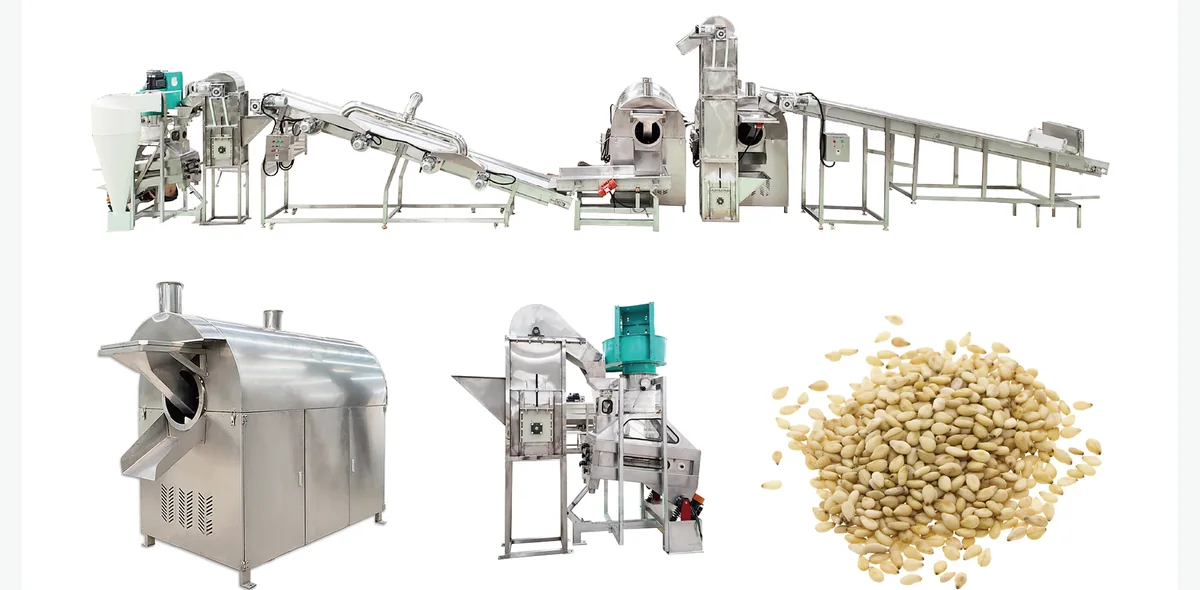
The sesame and nut roasting line is built around a fixed sequence: feeding, stone and impurity removal, an electromagnetic or selected roaster, cooling, and then either an optional seasoning stage or straight to the packing interface. Six positions, and each one has a job that can be lost if it is treated as a conveyor between the interesting parts.
- Feeding. Metered material in, at a rate the drum can actually take. Uneven feeding is read by the drum as a changing load, and a changing load roasts unevenly even at a fixed setting.
- Stone and impurity removal. A physical separation step, not a quality gesture. Discussed in section 4.
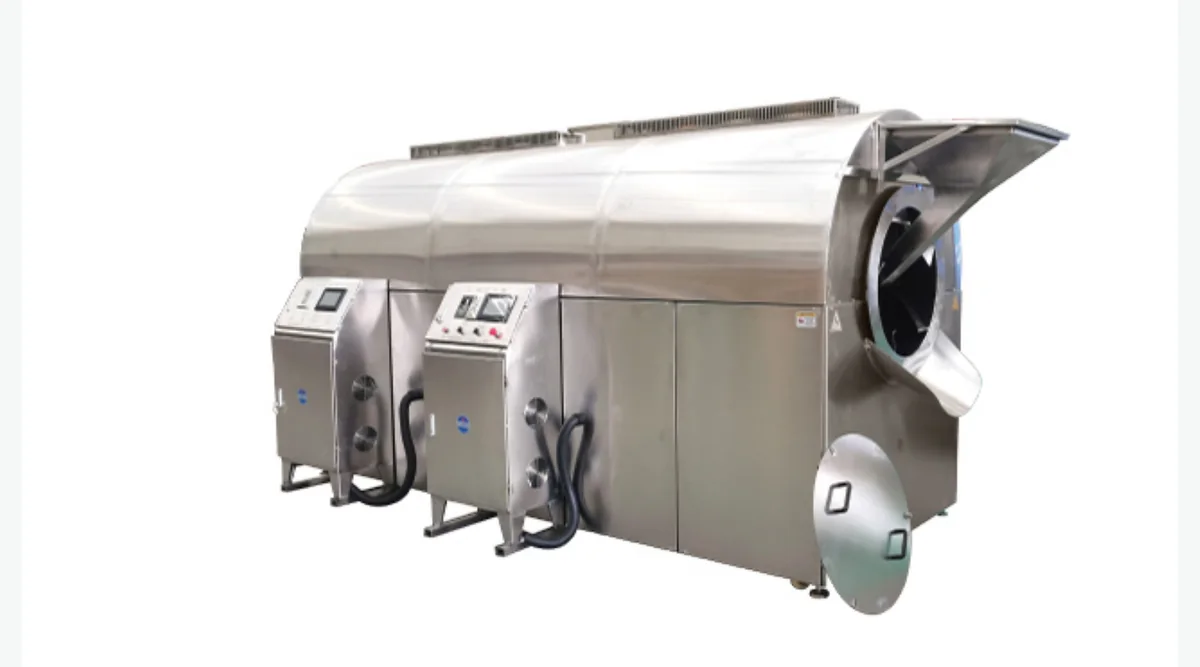
- Roasting. The only stage that creates the product's character, and the only one that needs a material-specific trial.
- Cooling. Ends the roast. Discussed in section 7, because it is the most commonly under-specified stage on the whole line.
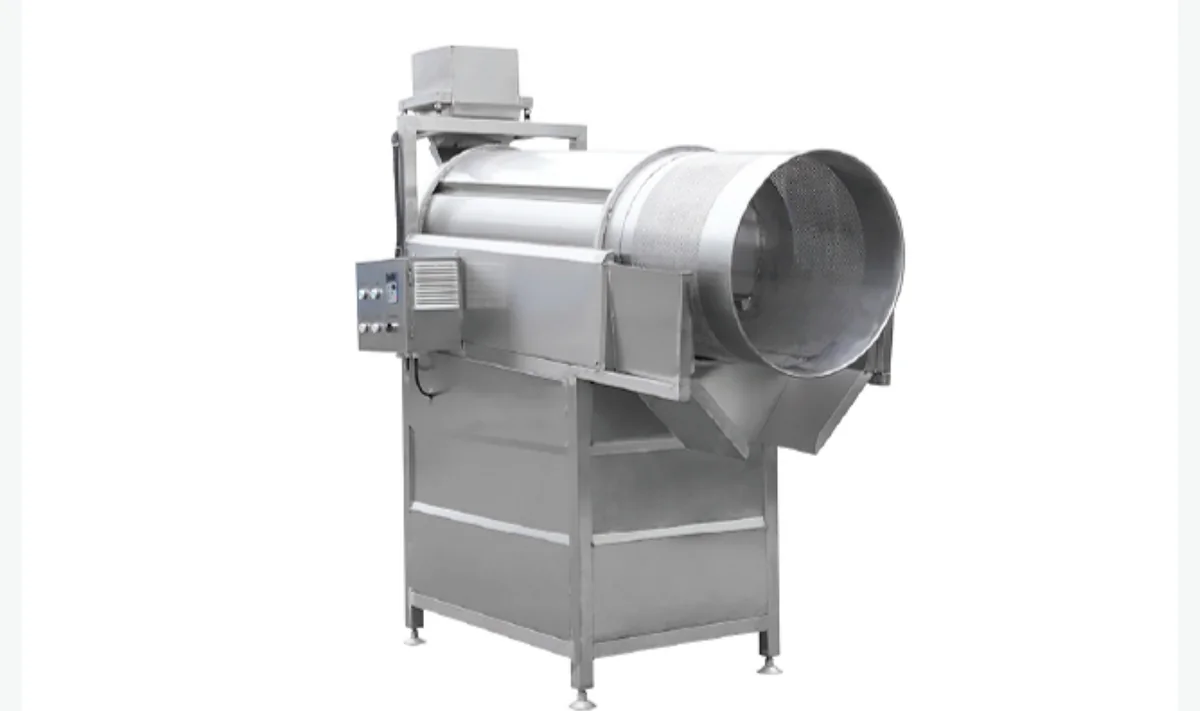
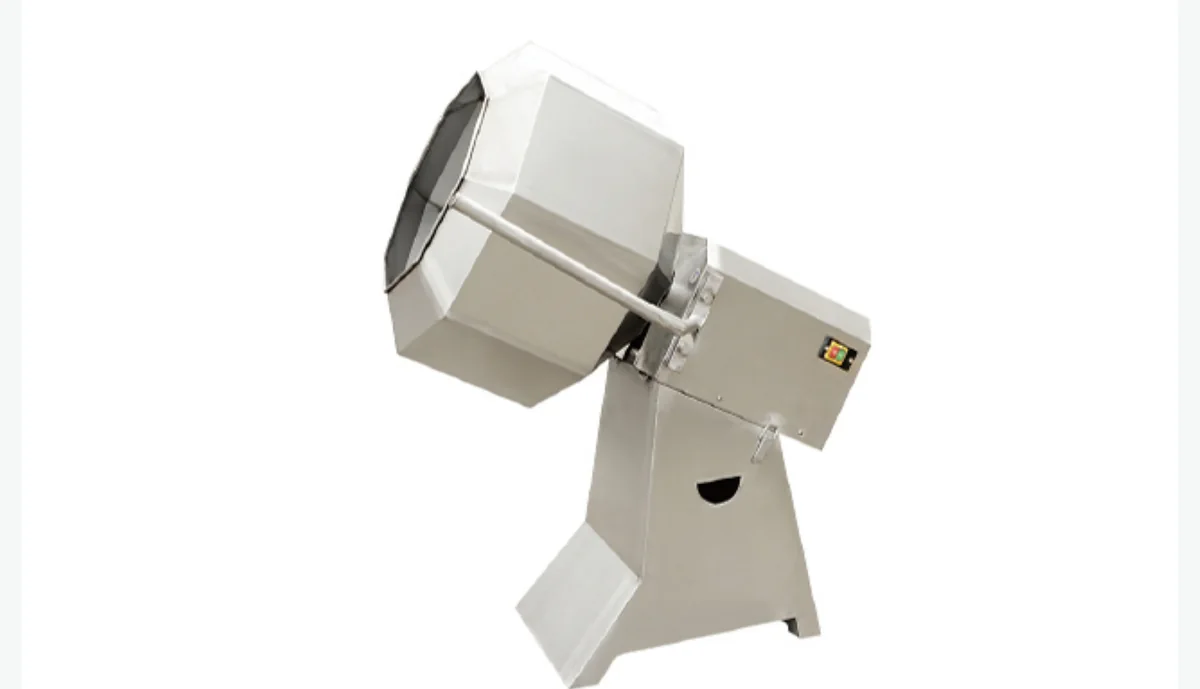
- Optional seasoning. A separate scope item, not a standard part of every roasting line.
- Packing interface. The point where the line's output meets the pack format, and where temperature at packing becomes a quality decision rather than an equipment detail.
Write the stage list into the project brief and mark, on that list, which stages are inside the supplier's scope and which are yours. A line quotation that covers the drum and cooling but not the feeding arrangement or the packing connection is not wrong — it is simply a partial scope, and partial scopes are where installation surprises come from.
3. The material specification comes before the machine
The single most useful page a buyer can send is a material description, not a capacity request. The nut and seed roasting application page lists what has to be in it, and the list is short enough to complete in one sitting.
Identity and physical state
Not "sesame" but which sesame; not "peanuts" but whole, shelled, split, blanched or coated. Size range and bulk density change how the material behaves in a drum, how it flows through a destoner and how much of it fits in a batch. Two suppliers quoting "peanuts per hour" against different physical states are not quoting comparable machines.
Inlet condition
Starting moisture, surface condition, temperature and impurity level. Material arriving wet, or arriving with a high stone or husk fraction, is a different feed problem from clean dry material, and the front of the line has to be sized for the condition you actually receive rather than the condition in the sample you sent.
Heat sensitivity and acceptable loss
How the material responds to heat is the core of the roast, and acceptable loss — breakage, splits, discoloured pieces, fines — is the number that decides whether a drum action is suitable. Breakage in particular is usually decided by mechanical handling rather than by temperature, which is why the supplier documentation treats drum action and product fragility as one question.
Intended finished product
Colour, aroma, texture, and whether the product is sold whole, milled, used as an ingredient or packed as a snack. A roasting line feeding a tahini or paste operation has different priorities from one feeding a retail snack pack, and the difference shows up in the roast endpoint, in the cooling route and in the pack format long before it shows up in the machine model.
4. Impurity removal belongs upstream of the drum
Stone and impurity removal sits second in the sequence for a reason: it protects everything behind it. A stone that reaches a roasting drum is a mechanical risk to the drum and a quality risk to the batch. Husks, dust and light fines carried into the roaster burn differently from the product, produce smoke and odour, and end up in the finished batch.
Three planning points follow.
- Specify the incoming impurity level, not an assurance that the material is "clean". The separation step is sized on a real feed condition.
- Decide where the rejects go. A destoner that discharges into a bin somebody has to empty every hour is a staffing requirement, and it belongs in the labour plan.
- Plan dust handling with the separation step and with the roaster, not after both. Dust and exhaust collection is part of the roasting line's scope discussion, and retrofitting a collection route into a finished layout is expensive.
Where the material arrives already cleaned by an upstream supplier, the step may still be needed as a guard — but that is a decision to record, with the reason, rather than to leave out silently.
5. The roast endpoint is a sample, not a setpoint
This is the heart of the matter. The customer who rejects a batch is not checking the heater setting; they are looking at colour, smell, bite and breakage. So the project has to define the endpoint in those terms and then find, by trial on the actual material, the operating conditions that produce it.
Agree the endpoint in the customer's language
Target colour against a retained reference sample, an aroma description, a texture or bite description, and an acceptable breakage level. Agree who judges, on which sample and with which light. Colour judgement under a factory sodium lamp and under daylight are not the same judgement, and the argument after the first shipment is always about which one applied.
Then find the settings that reproduce it
Time, temperature and loading interact. Running hotter for less time and cooler for longer can land on similar colour with different interior texture and different weight loss; which of the two is acceptable is a product decision. This is exactly why the electromagnetic drum roaster documentation insists that roasting time, temperature profile and cooling be validated with the actual material, and why the roaster page declines to carry a single "recipe".
Why one recipe does not transfer
Sesame, peanuts, almonds, other seeds, grains and spices differ in size, bulk density, starting moisture and heat sensitivity. A profile confirmed on one is a starting hypothesis for the next, nothing more. Two consequences for planning:
- Budget a trial per material, not one trial per machine. A line bought for three products needs three trials before the settings are locked.
- Write the number of materials into the brief from the start, because it decides whether the line can be single-purpose or has to be changeover-capable, which is section 9.
6. Heat source and the control scope
The roaster uses electromagnetic induction heating applied to the drum, which the supplier documentation describes as intended to reduce intermediate heat-transfer loss. Whatever the heating method, the planning questions are the same four.
- What the site can run. Available power, phase and frequency, reliability at peak demand, and who maintains the equipment locally. Voltage is matched to the destination electrical standard after those are confirmed.
- The control scope, in writing. Temperature measurement and control can be configured, but what exactly is measured, where the sensor sits, what is controlled automatically and what an operator adjusts by hand has to be listed. A roaster whose "temperature control" means a dial and a thermometer is a different machine from one with a recorded profile.
- The electrical load of the selected model. Ask for it as a figure in the technical proposal, not as a range. It is what your electrical works are designed against.
- How energy gets compared. Only under the same material, the same loading and the same roast target. The roaster page is explicit that energy use depends on product, loading and roasting target, and that an unverified percentage-saving claim should not be relied on. Ask for the test conditions behind any efficiency figure you are shown; if there are none, treat the figure as marketing.
Electrical readiness is the wider version of this question, and the line utility planning guide lists what has to be settled before a layout is approved: supply capacity, connection point, earthing, ventilation and the space around the equipment for maintenance.
7. Cooling is part of the roast, not the queue for packing
Heat does not stop working when the material leaves the drum. The piece is still hot, and the reactions that produced the colour and aroma continue while it stays hot. Cooling is therefore the stage that ends the roast, and how fast and how evenly it happens is part of the product specification — not a logistics detail.
Three things to specify
- Cooling method and how the material is handled through it. Gentle handling matters more here than anywhere else on the line, because roasted material is more brittle than raw material.
- Cooling endpoint. Agree the condition at which the product is considered cooled, and how it is checked, rather than "until it feels cool".
- What happens at discharge. Immediately into seasoning, into a buffer, or into packing. Each choice changes the equipment between the cooler and the pack.
The failure this prevents
Packing warm roasted product into a sealed bag traps heat and moisture in a closed space. Condensation forms inside the pack, the texture softens and the aroma changes. The cause is on the cooling stage and the symptom appears at the customer, which is the worst possible place to discover it. The cooling stage belongs in the acceptance test for exactly this reason — the sample that gets judged should be a cooled sample, judged as the customer would receive it.
Because cooling sits between two hot and dusty stages, exhaust and dust collection should be reviewed across roasting and cooling together rather than stage by stage.
8. Seasoning: a separate scope, and a separate set of questions
Seasoning is optional on a roasting line, and it is a separate scope item rather than an accessory. If the product is coated, three questions decide the machine.
Batch or continuous
A batch seasoning machine doses and mixes a defined batch; a continuous seasoning machine tumbles product at line rate between roasting or cooling and packing. The choice follows the operating rhythm of the whole line, not a preference: a continuous roaster feeding a batch seasoning stage creates a buffer requirement that has to exist somewhere.
Dosing accuracy and coating uniformity
Seasoning is a cost line and a taste-consistency line at once. Ask how the dose is set and how it is checked, and for continuous machines how drum angle, speed and residence time are checked against coating uniformity and breakage. Product fragility limits how much drum action is available, so on a brittle roasted product the seasoning stage can become the constraint on the whole line.
Allergen cleaning
If the line runs seasoned and unseasoned product, or products carrying different allergens, the cleaning requirement between runs is a design input. Dosing equipment, drums and transfer points all retain material. The seasoning machine documentation treats allergen-cleaning requirements as part of the final scope for this reason, and it is far cheaper to design for than to retrofit.
9. Changeover: the question that decides the whole layout
One material or several is the fork in the road. A single-purpose line can be optimised around one feed condition, one profile and one cleaning regime. A multi-material line has to be planned around what happens between runs.
- Cleaning. What has to be opened, emptied and cleaned between materials, and how long that takes with the access the layout provides.
- Allergen control. Where allergen-bearing material can be retained, and what procedure clears it. Facilities processing different nuts or seeds need defined cleaning and allergen-control procedures, not an assurance that the drum runs empty.
- Record keeping. Which profile applies to which material, and where that record lives. A line that depends on one experienced operator's memory is a line with a single point of failure.
- Changeover losses. The first output after a changeover is not saleable at full value, and neither is the material left in transfer points. Plan for it rather than discovering it.
One caution worth stating plainly
A roasting machine description is not evidence of a validated microbial reduction step. If the product or the market requires a validated reduction, that validation is a separate project on the actual product, with its own parameters, testing and documentation. Do not let a line specification stand in for it.
Nor should a sesame line be assumed suitable for every nut without a handling and process review. Peanuts, sesame and spices differ in size, bulk density, starting moisture and sensitivity to heat; the cleaning, destoning and seasoning stages may each need to be different machines on the same line.
10. Capacity basis, layout and utilities
State capacity as a basis, not as a number: raw material in per hour, or finished product out per hour, at a stated material condition and a stated operating pattern. As with drying, raw input and finished output are never the same figure once roasting loss and rejects are counted, so a line quoted on one basis against a requirement written on the other can be badly mismatched.
Then put the physical facts on a drawing: floor space along the whole route, clear height above the roaster and cooler, door width and installation access, the feed arrangement from the store, the exhaust and dust route to outside air, drainage for cleaning, and the space the packing interface needs. A line sized for average output is often short at peak, which is why the line page asks for peak input and expected expansion alongside average output.
The equipment RFQ checklist covers the commercial side of the same preparation — scope boundaries, which machines and conveyors are included, spares, installation support and training — so that the quotation being compared is the same scope as the one being asked for.
11. The acceptance test is written before the order
The line page states the requirement directly: define the result before final configuration, and agree the sample, the roast colour or moisture target, the acceptable breakage, the test batch and the inspection method. Add five practical items to that list and the test becomes usable.
- Which material, from which lot, in which condition — recorded, so a later batch can be compared against a known start.
- Who judges colour and texture, against which retained reference sample, under which light.
- Which moisture method and instrument, if moisture is part of the target, and where the sample is taken.
- Breakage and loss measured the same way each time, on a stated sample size.
- Whether the judged sample is a cooled sample, and after how much cooling.
Accept on the finished, cooled product at the agreed condition — not on the heater setting, the drum speed or a nominal hourly rate. Those are operating parameters; the contract is about output.
Roasting line planning checklist
- Material list with size range, physical state (whole, shelled, split, coated) and bulk density
- Inlet moisture, surface condition and impurity level, from the condition actually received
- Intended finished product: colour, aroma, texture, breakage limit and pack format
- One trial planned per material, with the trial material and lot recorded
- Impurity removal sized on real feed, with rejects route and dust collection defined
- Heating method, selected electrical load and control scope listed in writing
- Cooling method, cooling endpoint and discharge route agreed
- Seasoning positioned in the flow, with dosing check and allergen cleaning defined
- Changeover procedure and time allowance for a multi-material line
- Capacity stated on one basis, with peak and expansion noted
- Layout facts on a drawing: space, clear height, access, exhaust route, drainage
- Acceptance test written: sample, judge, light, moisture method, breakage measure, cooled sample
Frequently asked questions
Can the same roast settings be used for sesame and peanuts?
They should not be assumed. The supplier documentation for both the roasting line and the drum roaster say plainly that one recipe is not transferable, because sesame and peanuts differ in size, bulk density, starting moisture and sensitivity to heat. Each material needs its own trial with the actual sample, and the finished condition has to be agreed before operating settings are fixed. Where a line runs several materials, budget several trials.
What defines a roasting trial for nuts or seeds?
A trial needs the material, its inlet moisture state, the intended roasting rhythm and the target roast profile, then records time, temperature and the downstream cooling result on that material. A trial that only shows a heater setting is not a result: what has to be repeatable is the colour, aroma, texture and breakage of the finished product after cooling. Agree before the trial who judges the sample and against which reference.
Is a roasting machine the same as a dryer?
No. A dryer is bought as a water-removal duty: a defined water load per hour, taken to a target moisture. A roaster develops colour and aroma through heat applied to the material for a defined time. Some water is lost in roasting, but the specification, the trial and the acceptance criteria are different, so the two routes are planned separately — see the drying line planning guide for the water-removal route.
How should energy use of an electromagnetic roaster be compared?
Compare the same material, the same loading and the same roasting target under agreed test conditions. Ask for the selected electrical load and the control scope in writing, and do not rely on an unverified percentage-saving claim. Energy use depends on the product, the loading and the roast target, so a comparison made on different products tells a buyer nothing.
Does a roasting machine guarantee a microbial reduction?
No. A machine description is not evidence of a validated microbial reduction step. Any such claim belongs to a documented process validation on the actual product, with the actual parameters and the actual testing method. Ask separately what food-safety controls the process needs and who is responsible for validating them.