A potato chips line is usually discussed in the order the machines stand: washer, peeler, slicer, blancher, dryer, fryer. The two stages that actually define the product the customer buys — the coating on the chip and the bag it arrives in — come at the end of that sentence, and they usually get the smallest part of the planning budget.
That order is backwards, for one practical reason. The back end produces two numbers that the front end has to satisfy: a coating weight per unit of product, and a bag count per hour at a stated pack weight. Both are measurable, both are written into an acceptance test, and both constrain what the fryer has to deliver. Planning them after the fryer is chosen means the fryer is chosen against an assumption.
1. Why the back end is planned last and paid for first
The reason is structural. Frying is the visible, expensive, technically interesting part of a chips line, so it attracts the site visits and the technical discussion. Seasoning looks like a drum with a dosing auger, and packing looks like a machine you buy from a different supplier. Neither looks like the place where a project fails.
In practice three of the most common commissioning complaints come from exactly there. Coating that does not bind because the product arrives at the seasoning drum carrying the wrong amount of surface oil. A packing stage that cannot hold its fill weight because the weighing system was matched to the wrong product. A line that runs at its rated output on paper but not on the floor, because the fryer output was never converted into the bag count the packing machine has to hit.
None of those are machine faults. All three are specification gaps, and all three are cheap to close before the order and expensive to close afterwards. The process route itself — washing, peeling, slicing, blanching, drying, frying, de-oiling, seasoning, packing — is set out in the potato chips line equipment guide; this page takes the last three stages and works them properly.
2. The stage order after the fryer, and what each one decides
Between the fryer and the sealed bag there are four stages, and each one hands a condition to the next. The published product descriptions on this site define them narrowly and usefully:
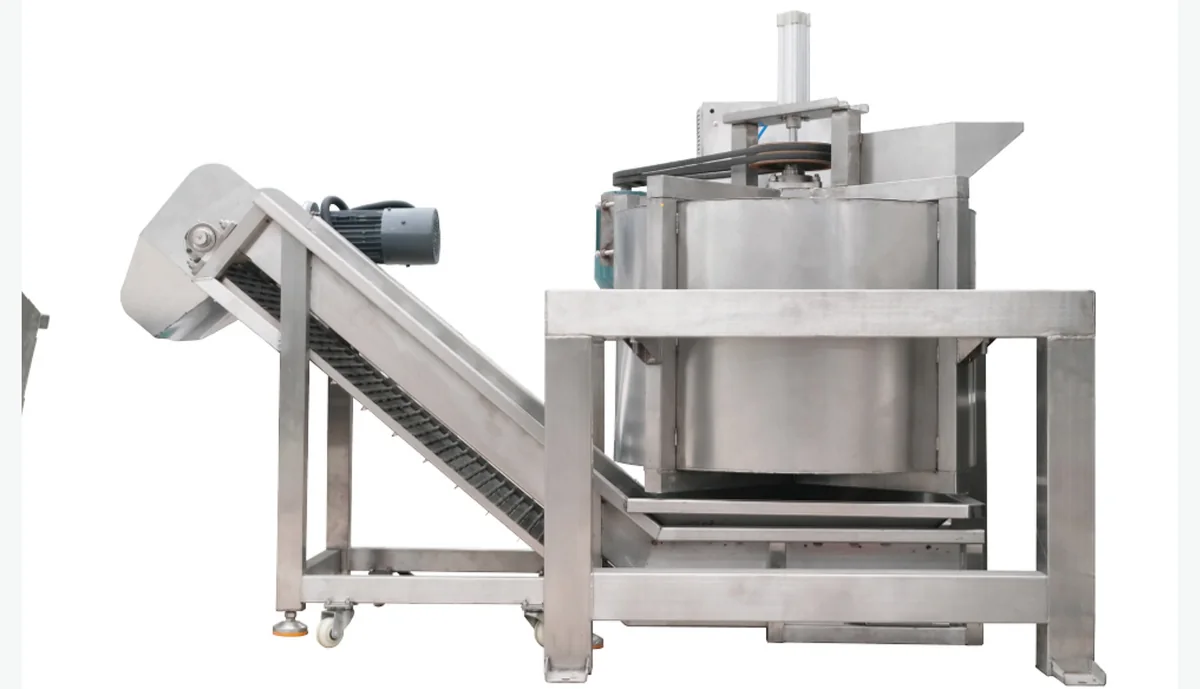
- De-oiling — a centrifugal de-oiling machine removes surface oil from suitable fried foods before cooling, seasoning or packing. It is a batch machine, so its cycle has to be added to the fryer cycle rather than optimised separately.
- Cooling — the continuous seasoning machine page describes its input as product moving from frying or cooling toward packing. That wording matters: whether cooling is a separate machine, a conveyor run, or a waiting period is a layout decision, and it changes both floor space and the coating result.
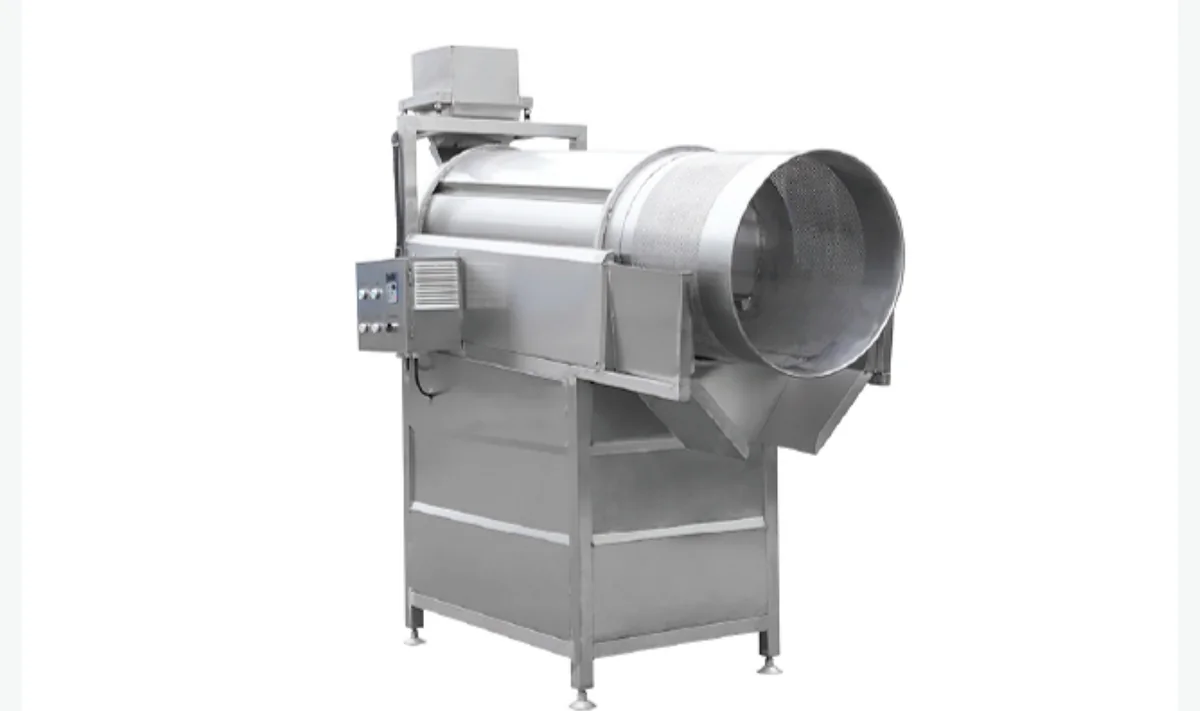
- Seasoning — a batch seasoning machine or a continuous seasoning machine applies dry seasoning, or an agreed coating, to the product.
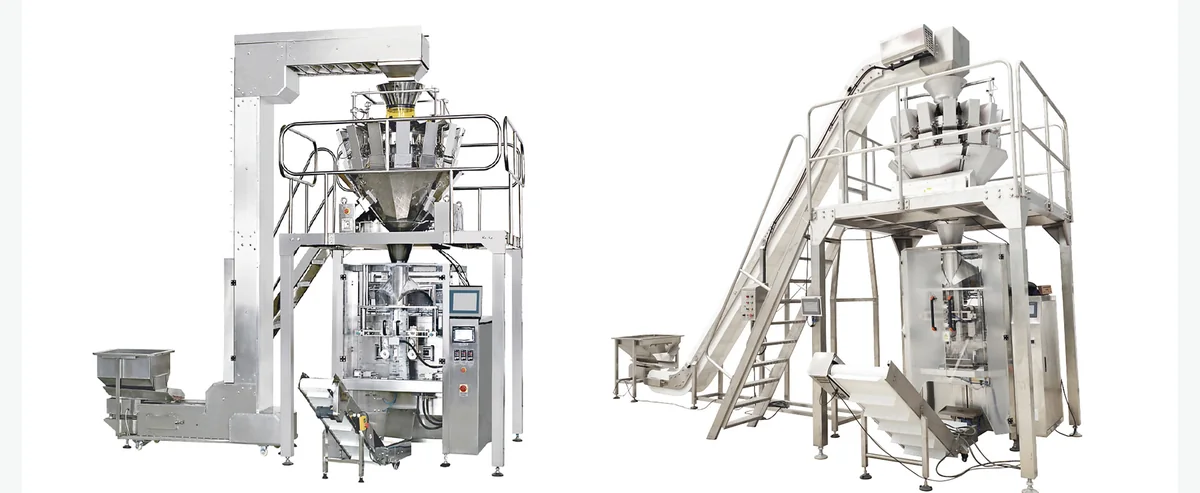
- Packing — a vertical form-fill-seal bagger combines product feeding, multihead weighing, bag forming, sealing and finished-pack conveying.
The condition handed along that chain is surface oil and surface temperature. Seasoning binds onto a surface; if the surface carries too much oil the powder clumps and the bag turns greasy, and if the product is still hot when it reaches the pack the film sees vapour it was not specified for. De-oiling and cooling are therefore not optional housekeeping between two important machines — they are the specification of the seasoning stage's input.
3. Coating weight is an acceptance number, not a description
Buyers describe seasoning in adjectives: evenly coated, well seasoned, typical for the market. None of those can be tested, and none of them can be quoted against. The seasoning pages on this site convert the description into a measurement, and the measurement is worth copying into your own specification.
The agreed test is one specified product and one seasoning setup, recording four things: the incoming weight, the finished weight, the coating distribution across the product, and the variation in coating weight you will accept. Alongside those, record the flavour batch used and the sample size — in the same document. The reason is that coating weight is checked by weighing, and a weighing result without the batch identity and the sample size cannot be repeated by a second party, which means it cannot settle a dispute.
What the number should be is a commercial decision, not a technical one, and it is not published here. What can be said is that the tolerance band has to be agreed before the trial, because a result produced against no band is always argued about afterwards.
Powder and liquid are different arrangements
Both seasoning pages make the same point in different words: a powder blend and a liquid glaze are handled by different arrangements inside the machine. That single sentence decides more of the quotation than the machine size does. It changes the dosing method, the surfaces that need cleaning, and whether the machine needs a warmed surface at all — the batch seasoning page notes that electric heating is used only where the seasoning needs it, and that otherwise the line runs unheated.
So state the flavour format in the enquiry, not just the flavour name. "Barbecue seasoning" describes a taste; the machine specification needs to know whether that arrives as a dry blend or as a liquid, and at what coating weight.
4. Batch or continuous seasoning: decide by flow, not by price
The two seasoning machines on this site are not two sizes of the same thing. The continuous machine takes product moving from frying or cooling toward packing and applies dry seasoning in a tumbling drum; its published sequence is continuous product feeding, controlled tumbling and distribution, then discharge to inspection or packing. The batch machine works on a defined batch weight, with a drum or bowl action, and lists potato chips, banana chips, nuts, fried snacks and suitable prepared foods among its applications.
Three questions separate them.
- Is the product flow steady? A continuous machine has to be fed at a rate it can dose against. The page asks for product feed and seasoning dose to be interlocked where required, which is a statement that the two are a single control problem.
- How many flavours per shift? A batch machine changes over between defined batches. A continuous machine changes over inside a running line, and both need cleaning and dosing time that belongs in the shift figure rather than being absorbed silently.
- How fragile is the product? The continuous page requires drum angle, speed and residence time to be checked against coating uniformity and breakage. The batch page requires drum or bowl action to be checked against product breakage. Both are telling you the same thing: the seasoning stage is a mechanical handling stage, and a chip that breaks there is a bag of crumbs.
Where either seasoning mode is technically suitable, review the packing stage and the complete operating schedule before deciding. A packing stop may require upstream pacing, a planned line stop or a reviewed buffer. A batch seasoning machine is not automatically a suitable buffer: usable capacity, permitted holding time, product quality and the restart sequence must be confirmed for the actual equipment.
For projects where the production mode itself is still undecided, settle that first in the batch versus continuous fryer guide — the seasoning stage cannot fix a mismatch created upstream.
5. What the product arriving from the fryer decides
Both seasoning pages open their configuration list with the incoming material, and both phrase it in a way worth reading closely: state the fried product arriving from the fryer, its size range, and how much oil it still carries, because the seasoning has to bind onto that surface. Give the flavour format and the target coating weight. Say how many flavours the machine has to hold.
That is four inputs, and a buyer who supplies only the fourth will get a quotation that cannot be compared with anyone else's. Size range matters because it sets the drum or bowl action and the transfer gaps. Residual oil matters because it is the difference between a coating that adheres and one that slides off into the bag. Flavour count matters because the dosing head, the flavour hoppers and the discharge conveyor are configured by project and sized to the number of flavours — not to the machine's nominal size.
The upstream stages decide that residual oil, which is why the frying and de-oiling specification and the seasoning specification have to be written by the same person on the same day. If de-oiling is a batch centrifugal step, its cycle length directly changes how much oil is left when the product reaches the drum. Batch scheduling is covered from the fryer side in the round pot and batch fryer comparison; from the seasoning side the question is simply whether the de-oiled batch waits, and for how long.
6. Flavour changeover and allergen cleaning
This is the part of a seasoning specification that is most often left out and most often regretted. The batch seasoning page places seasoning dosing and allergen-cleaning requirements in the final scope, and asks for the cleaning procedure between recipes to be recorded together with product discharge. The continuous page asks for cleaning and recipe-change requirements to be included when the transfer and control scope are agreed.
Put plainly: the machine that seasons flavour A will later season flavour B, and the cleaning between them is part of the machine's job, not an operator habit. Three items belong in writing before the order:
- Which surfaces contact seasoning, and how they are opened for cleaning. The dosing head and the flavour hopper bank are separate cleaning areas from the drum itself.
- Who owns allergen cleaning. The batch page asks for allergen-cleaning responsibilities to be stated before order confirmation, which implies the answer can be either party — as long as it is written down.
- How a hopper is exchanged. Hoppers are sized to the flavour count, and swapping one is a physical operation that needs floor space and access at the machine, not just a change on the control screen.
Changeover time then enters the shift figure twice: once as lost seasoning time, and once as lost packing time if the packing machine has nothing to pack while the drum is being cleaned.
7. The pack format picks the packaging machine
A vertical form-fill-seal bagger is specified from the pack, not from the machine platform number. The packaging page on this site makes that explicit in its first FAQ: start with the required bag dimensions, film structure and target pack weight, then confirm the forming, sealing and weighing configuration with the actual product rather than choosing from the platform number alone.
Four inputs drive the selection:
- Bag dimensions and pack weight — the film roll, the dosing system and the sealing jaw all follow from the pack size and the product density.
- Product texture and fill tolerance — a free-flowing product and a piece product are dosed differently, and the acceptable fill tolerance has to be stated as a number.
- Bags per hour and working hours — capacity is sized on packs per hour together with the changeover time when pack size changes.
- Film structure — named in the specification, because the sealing window and the pack appearance both depend on it.
Two further points are easy to miss. First, the page states that actual speed and accuracy depend on product behaviour, target weight, bag format and the selected weighing system — so a headline bag count from another project is not a specification for yours. Second, a vertical bagger is tall: the page asks you to check machine height against the room's clear height, because the film roll sits above the operator. A building with a low clear height can rule out a configuration before any other consideration applies.
Where the requirement is to grade or separate product by weight before packing rather than to fill to weight, that is a different machine — a weighing and sorting conveyor line classifies product by configured weight ranges and discharges it to separate collection positions.
8. What is not in the box
The packaging page answers this question directly, and the answer is worth repeating because it is the single most common source of an unexpected cost line. Film, date coding, nitrogen flushing and inspection interfaces require separate confirmation. The page instructs the buyer to list the selected modules and any site utilities explicitly in the equipment scope.
The same logic applies one stage upstream. The seasoning machine's dosing head, flavour hoppers and discharge conveyor are configured by project, sized to the number of flavours — they are scope items, not accessories. And the transfer between stages is itself a scope question: who supplies the conveyor from the de-oiler to the drum, and from the drum to the bagger infeed, is a line in the offer, not an assumption.
Three practical consequences follow. Compressed air is used where the machine specifies it, so a site survey that records only electrical capacity is incomplete. Extraction at the seasoning dosing point matters because fine powder is transferred there, and the seasoning page lists it with the floor area for the hopper bank as layout items. And if nitrogen flushing is intended, the gas supply becomes a utility with its own place in the layout, not a later addition.
9. Line balance: bags per hour versus kilos per hour
This is where the two ends of the line are reconciled, and it can be done on one line of arithmetic before any quotation is requested.
The fryer and upstream equipment are sized in product weight per hour. The seasoning machine is sized on fried product weight per hour with the coating target included. The packaging machine is sized in packs per hour. The conversion between them is the pack weight:
seasoned product per hour = pack weight × packs per hour
Compare effective stage capacities on the same finished-product mass basis and under the same operating assumptions, including coating addition, planned stops and changeover. If packing capacity is lower than the upstream delivery rate, packing may limit the line. If packing capacity is higher, packing may wait for upstream supply; that does not by itself make packing the bottleneck. Identify the limiting stage from actual measurements rather than ruling out equipment or control faults without investigation.
Two adjustments belong in the same calculation. The first is de-oiling: a batch centrifugal step adds a cycle that the product waits through, so the flow rate through the back end is not the fryer's instantaneous output. The second is changeover: a pack size change costs a film roll change and a re-set of the dosing volume, and a flavour change costs cleaning and dosing time. Both come out of the shift, and both are named as shift-figure items on the pages that describe the machines.
A buffer can accommodate short interruptions only within its agreed usable capacity, holding time and product-quality limits. It cannot compensate for a sustained downstream capacity shortfall. Review the operating rhythm, usable storage volume and restart rate together. If the project is still at the routing stage, use the commercial potato chips line planning guide to align the requirement, process route and packing plan.
10. Vacuum packing is a separate decision, not an upgrade
A vacuum packaging machine is for products that require reduced package air before storage or distribution, and its chamber and seal-bar dimensions must match the final pack. For ambient snack chips in a gas-flushed vertical bag, that is usually a different question from the one being asked.
Where vacuum packing is genuinely under consideration, the page is careful about one thing and the care is worth passing on: shelf life depends on the product, hygiene, packaging material, storage temperature and validation, and is not guaranteed by the machine alone. A packaging machine does not replace the required food-safety process. Any shelf-life claim in a project plan should therefore cite a validation, not a machine.
The specification inputs are the same discipline as the bagger: product, pack format, pack weight, expected residual air level, whether the product is chilled, frozen or ambient, packs per hour, changeover time, film rolls held, and the power for the pump and sealing jaw separately. The acceptance test is a seal width, a leak test result, a residual air level and a pack appearance, recorded with the film specification and the sample size.
11. Layout and utilities at the back end
Both seasoning pages give the same instruction, and it is a layout instruction rather than a machine instruction: the seasoning machine sits between the fryer and the packing line, so plan that straight run first. Then check the floor area for the dosing head and the flavour hopper bank, the extraction at the dosing point, the power supply against the dosing equipment, and access for a hopper to be exchanged.
The packaging side adds its own list: machine height against clear height, product infeed height, discharge conveyor height, film roll position, compressed air if used, and space for the finished packs to go somewhere. Vacuum packs stack, and vertical bags need a case-packing or collection point — the page notes that the output buffer takes room.
Three of those are routinely underestimated. The hopper bank is floor area in front of the machine, not on it. The extraction at the dosing point needs a duct route, which competes with the ceiling height the bagger already needs. And the straight run from fryer to bagger, taken literally, is a long piece of floor that cannot be interrupted by a column.
Electrical capacity should be recorded per load, not in total: the dosing drive, any warming load on the seasoning machine, the forming and sealing load on the bagger, and the pump and sealing jaw on a vacuum machine are listed separately on their pages precisely because they are specified separately. The sequence for working through power, fuel, water and drainage is in the utility planning guide.
12. What the commissioning test has to prove
Acceptance at the back end is two tests, not one, and they should be written before the order.
The seasoning test runs one specified product and one seasoning setup. Record the incoming weight, the finished weight, the coating distribution across the product and the accepted variation in coating weight. Record the flavour batch used and the sample size in the same document.
The packing test runs one specified product and one pack size. Record the fill weight across the sample, the acceptable weight tolerance, the seal area and the seal appearance, plus the film specification, the machine speed, the sample size and the number of samples.
Then run the two together, for a shift, at the pack weight and bag count you intend to sell. That third test is the only one that answers the line-balance question in section 9, because it is the only one where the buffer, the changeover and the two acceptance standards are active at the same time. What it produces — bags per hour at a stated fill tolerance, and a coating weight within a stated band — is what the project was actually buying.
Clean down between two flavours during that shift as well, and write down the steps and the time. A changeover that was never timed in the factory will not be timed in the quotation either.
Back-end planning checklist
- Finished pack fixed first: pack weight, bag format, bags per hour
- Coating weight target and accepted tolerance band written down
- Flavour format stated as dry blend or liquid, with flavour count
- Residual surface oil and product size range given to the seasoning supplier
- De-oiling cycle and cooling arrangement decided, not assumed
- Batch or continuous seasoning chosen from flow pattern and flavour count
- Allergen-cleaning responsibility stated in the equipment scope
- Film, date coding, nitrogen flushing and inspection interfaces named or excluded
- Line balance calculated as pack weight × packs per hour against fryer output
- Buffer space between seasoning and packing drawn on the layout
- Clear height checked against bagger height and film roll position
- Extraction, compressed air and per-load electrical capacity recorded
- Seasoning and packing acceptance tests defined before the order
- Changeover between two flavours timed during the trial shift
Frequently asked questions
Should I choose a batch or a continuous seasoning machine?
Choose from the product flow, required batch size, flavour changes and actual equipment tests. Continuous seasoning requires the product flow and seasoning dose to be matched. Batch seasoning works on a defined load. If packing stops, review upstream pacing, planned stops and any proposed buffer; neither machine type automatically guarantees suitable holding capacity or product quality.
How is coating weight agreed and checked?
By weighing, against a written tolerance. The seasoning pages on this site set the test as one specified product and one seasoning setup: record the incoming weight, the finished weight, how the coating is distributed across the product, and the variation in coating weight you will accept. Record the flavour batch used and the sample size in the same document, because a coating result without the batch and sample size cannot be repeated or disputed.
Are nitrogen flushing, date coding and check-weighing included in a packaging machine?
Do not assume so. The vertical packaging machine page lists film, date coding, nitrogen flushing and inspection interfaces as items requiring separate confirmation, and asks for the selected modules and any site utilities to be written into the equipment scope. A quotation that does not name them is not necessarily excluding them — but you cannot plan a line around modules that are not written down.
Can packing speed be compared between two quotations as bags per hour?
Only on the same product, pack weight, bag format and weighing system. The packaging page states that actual speed and accuracy depend on product behaviour, target weight, bag format and the selected weighing system, and that capacity is sized on packs per hour together with the changeover time when pack size changes. Compare quotations on your own pack, not on a headline figure.
Does vacuum packing extend shelf life?
It reduces the air in the pack, which is a packaging function, not a shelf-life guarantee. The vacuum packaging page states that shelf life depends on the product, hygiene, packaging material, storage temperature and validation, and that the machine does not replace the required food-safety process. Treat any shelf-life figure as the result of your own validation on your own product.